
Our Take on the PARF Rebate: What Singapore Car Owners Should Know in 2026
What is PARF Rebate?
The Preferential Additional Registration Fee (PARF) rebate is a rebate that eligible vehicle owners may receive when they deregister their car before it exceeds 10 years of age. In simple terms, it returns a percentage of the Additional Registration Fee (ARF) paid when the vehicle was first registered. The applicable percentage depends on the car’s age at deregistration and its registration cohort.
The PARF rebate is often described as a car’s “scrap value”, but this shorthand can be misleading. The actual amount depends on the vehicle’s registration cohort, exact age at deregistration, and netARF actually paid. It is separate from any COE rebate for the vehicle’s unused COE period and the commercial value obtained from its car body.
For Singapore car buyers, the key point is that the revised PARF rebate schedule does not apply simply because a car is deregistered in 2026. For cars requiring a COE, the applicable schedule is determined by the COE bidding exercise from which the vehicle’s COE was obtained. The revised schedule applies to cars registered with COEs obtained from the second COE bidding exercise in February 2026 onwards.
Key Takeaways
- The 2026 PARF rebate changes do not apply to every car deregistered in 2026. The revised schedule applies to cars registered with COEs obtained from the second COE bidding exercise in February 2026 onwards, as well as COE-exempt cars registered on or after 13 February 2026.
- Under the revised schedule, the PARF rebate ranges from 30% of net ARF paid for cars not more than five years old to 5% for cars above nine but not more than 10 years old. The rebate is capped at S$30,000.
- Existing cars remain subject to the PARF rebate schedule tied to their original registration cohort, even if ownership is subsequently transferred.
- When buying from a parallel importer in Singapore, ask for the car’s OMV, net ARF paid, registration cohort and estimated PARF rebate. This will help you assess its longer-term ownership cost more accurately.
- We recommend assessing the PARF rebate, COE rebate, body or export value, remaining COE period and overall ownership costs separately instead of relying on a single “scrap value” figure.
How We Calculate the PARF Rebate in Singapore
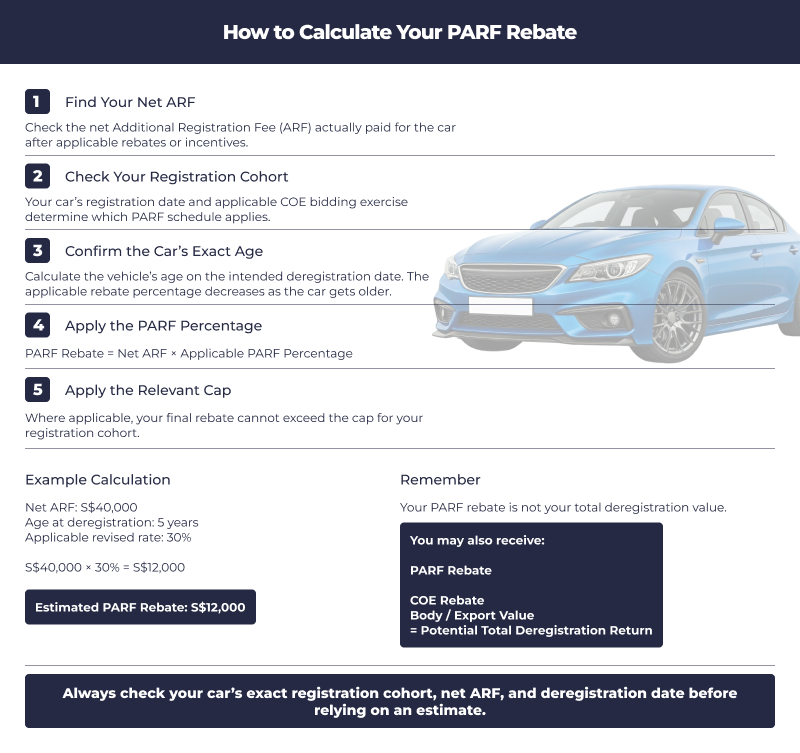
PARF stands for Preferential Additional Registration Fee. In simplified terms :
PARF rebate = Net ARF paid × Applicable age-based percentage
Where a cap applies, the rebate payable will be the lower of the calculated amount and the relevant cap.
The calculation begins with the net ARF paid, as this is where informal estimates often go wrong here. ARF is a progressive tax based on a vehicle’s Open Market Value (OMV), but the PARF rebate is based on the actual ARF paid after applicable rebates or incentives, not the vehicle’s OMV or its selling price.
For vehicles that receive tax incentives, such as VES rebates, the PARF calculation is based on the net ARF paid. LTA’s guidance sets out the applicable rebate schedules and caps.
Earlier and Revised Schedules
The change is easiest to understand by comparing the age bands directly:
| Age at Deregistration | Earlier Schedule | Revised 2026 Schedule |
| Not more than 5 years | 75% of ARF | 30% of ARF |
| Above 5 to 6 years | 70% | 25% |
| Above 6 to 7 years | 65% | 20% |
| Above 7 to 8 years | 60% | 15% |
| Above 8 to 9 years | 55% | 10% |
| Above 9 to 10 years | 50% | 5% |
| More than 10 years | Nil | Nil |
| Applicable cap | Up to S$60,000 for the intermediate cohort | S$30,000 |
Cars registered with COEs obtained from the second COE bidding exercise in February 2023 to the first COE bidding exercise in February 2026 are subject to the earlier rebate percentages, with the PARF rebate capped at S$60,000. Cars registered with COEs obtained before the second COE bidding exercise in February 2023 are subject to the same rebate percentages without the S$60,000 cap.
The revised PARF rebate schedule applies to cars registered with COEs obtained from the second COE bidding exercise in February 2026 onwards. For COE-exempt cars, the revised schedule applies to those registered on or after 13 February 2026.
What the 2026 Change Means for Car Owners
Budget 2026 reduced the PARF rebate rate by 45 percentage points across every age band and lowered the applicable cap from S$60,000 to S$30,000 for the new registration cohort.
Three implications are especially relevant.
1. Higher-ARF Cars Can See a Reduction in Dollar Terms
Consider a car with net ARF of S$100,000 that is deregistered within five years.
Under the earlier capped schedule, 75% of ARF is S$75,000, but the S$60,000 cap applies. Under the revised schedule, 30% is S$30,000, which reaches the new cap.
That represents a S$30,000 reduction in the PARF rebate alone. As a result,higher-ARF vehicles may experience a particularly significant reduction in dollar terms.
2. Keeping a Car Close to 10 Years Results in a Much Lower PARF Rebate
For an affected car that is more than nine but no more than 10 years old, the revised rebate rate is 5% of net ARF paid, compared with 50% under the earlier schedule.
For example, a car with a net ARF of S$30,000 would receive a PARF rebate of S$1,500 under the revised schedule, compared with S$15,000 under the earlier schedule.
For buyers planning to keep a car close to the end of its original COE period, the intended ownership duration now warrants closer consideration. A lower future PARF rebate affects one component of the vehicle’s total ownership cost.
3. Existing Used Cars Do Not Move to the Revised Schedule
A pre-owned car registered before the 2026 changes remains subject to the PARF rebate schedule assigned to its original registration cohort. A subsequent change in ownership does not move the vehicle to the revised schedule.
This means an older used car may retain a higher future PARF value than a newly registered car. However, buyers should still compare factors such as remaining COE period, mileage, condition, servicing history, purchase price, financing costs and expected maintenance expenses.
When comparing vehicles from a parallel car importer in Singapore or another dealer, ask for the original registration date, applicable COE bidding exercise, OMV, net ARF paid and estimated PARF rebate instead of relying solely on a single depreciation figure.
PARF Rebate vs COE Rebate: Why We Separate Them
A common misconception is that the PARF and COE rebates form part of the same calculation. They are calculated separately.
The PARF rebate is based on net ARF paid and the vehicle’s age at deregistration. The COE rebate reflects the unused portion of the COE premium paid. For an original COE, this is based on the Quota Premium (QP) paid; for a renewed COE, it is based on the Prevailing Quota Premium (PQP) paid.
A simplified calculation is:
COE rebate = QP or PQP paid × Unused COE period ÷ Original COE period
For example, if S$100,000 was paid for a 10-year COE and 24 months remain when the car is deregistered, the simplified COE rebate would be:
S$100,000 × 24 ÷ 120 = S$20,000
If the same car also qualifies for S$12,000 in PARF, the two statutory rebates would total S$32,000.
However, this may not represent the vehicle’s total deregistration proceeds. A dealer, exporter, or scrapyard may separately offer a body, scrap, or export value based on the vehicle’s condition and prevailing market demand.
When owners ask us about deregistering a car in Singapore, we recommend requesting an itemised breakdown showing:
- PARF rebate
- COE rebate
- Body, scrap, or export value
- Administration or processing fees
- Outstanding finance settlement
- Final net amount receivable or payable
This is more useful than comparing a single, undifferentiated “scrap value”.
Common PARF Rebate Mistakes We See
Using the Wrong Registration Cohort
A car deregistered in 2026 does not automatically fall under the revised schedule. Check its original registration details and the COE bidding exercise from which its COE was obtained before estimating the rebate.
Calculating the Rebate From OMV Instead of Net ARF Paid
OMV is used to determine ARF, but it is not the amount directly multiplied by the applicable PARF rebate rate. The calculation is based on the net ARF actually paid after applicable rebates and incentives.
For EVs and other vehicles that receive tax incentives, this distinction can materially affect the final PARF rebate.
Treating PARF Rebate as the Entire Deregistration Return
The statutory rebates should be separated from the vehicle’s commercial vehicle value. A quotation that combines the PARF rebate, COE rebate, and body or export value into a single amount makes it harder to understand exactly what you will receive.
Overlooking an Age Boundary
The applicable rebate rate decreases when a vehicle enters the next age band. We therefore calculate its exact age using the intended deregistration date instead of simply describing it as “about eight years old”.
Allowing the Rebate Expire
PARF and COE rebates are valid for 12 months from the vehicle’s deregistration date and must be used within this period. Owners should note the expiry date early, particularly if they intend to encash the rebate, transfer it or use it to offset eligible taxes and fees on another vehicle.
Do Electric Vehicles Receive Different PARF Treatment?
Electric cars do not follow a separate PARF rebate schedule simply because they are electric. The key difference is often the net ARF paid after applicable incentives.
For fully electric cars registered in 2026, the EV Early Adoption Incentive provides a 45% ARF rebate, capped at S$7,500. Qualifying cars in VES Band A may also receive a S$22,500 rebate, providing combined upfront ARF savings of up to S$30,000. The minimum ARF remains S$0 for fully electric cars registered up to 31 December 2027.
Since the PARF rebate is calculated using the net ARF paid, an eligible EV may have a relatively low ARF base after these incentives are applied.
For example, if a car’s gross ARF is S$40,000 and the applicable incentives reduce its net ARF to S$10,000, a revised-cohort car deregistered within five years would have an estimated PARF rebate of S$3,000.
We therefore recommend assessing the purchase price, net ARF paid, estimated PARF rebate, charging or fuel costs, road tax, insurance, maintenance expenses, and resale demand together instead of considering the deregistration value in isolation.
How We Recommend Checking Your Rebate
For a registered vehicle, start with LTA’s OneMotoring enquiry service. It estimates the applicable statutory rebates using the vehicle’s records and intended deregistration date.
For a manual estimate:
- Confirm the actual net ARF paid.
- Identify the vehicle’s registration cohort.
- Calculate its exact age on the intended deregistration date.
- Apply the relevant rebate rate and cap.
- Calculate the COE rebate separately.
- Add the body or export value only after confirming what the quotation includes.
Be cautious with calculators that ask only for the vehicle’s OMV and approximate age. In 2026, the registration cohort and actual net ARF paid are essential to an accurate estimate.
If you are planning to buy a new car in Singapore, review these figures before comparing models. A lower future PARF rebate should be considered alongside the purchase price, running costs, financing costs and intended ownership period.
Frequently Asked Questions
Does the revised PARF rebate apply to a car I owned before February 2026?
Generally, no. Existing cars remain subject to the PARF rebate schedule associated with their original registration cohort. The revised schedule applies to cars registered with COEs obtained from the second COE bidding exercise in February 2026 onwards, as well as COE-exempt cars registered on or after 13 February 2026.
What should I check before buying a car under the revised PARF rebate rules?
Before buying, check the car’s OMV, net ARF paid, registration cohort, remaining COE period, applicable PARF rebate schedule and intended ownership duration.
When you visit our car showroom in Singapore, we can review these figures with you so that you can better understand the car’s upfront price, estimated future PARF rebate and longer-term ownership costs.
Is the PARF rebate the same as my car’s scrap value?
No. The PARF rebate is a statutory rebate based on the ARF paid and the vehicle’s age at deregistration. Your total deregistration proceeds may also include a COE rebate and a separate body, scrap or export value.
Can I claim the PARF rebate when I sell my car?
A standard ownership transfer does not trigger the PARF rebate. It becomes available when an eligible vehicle is deregistered and the required disposal process is completed.
What happens when my car is more than 10 years old?
A car that is more than 10 years old is no longer eligible for a PARF rebate. If it has a renewed COE, a pro-rated COE rebate may still be available if the vehicle is deregistered before that renewed COE expires.
Can I use the PARF rebate towards another car?
Yes. Eligible PARF and COE rebates may be encashed, transferred or used to offset specified taxes and fees when registering another vehicle, subject to LTA’s rules and the 12-month validity period.
Our Perspective at Venture Cars
At Venture Cars, we believe Singapore car buyers should understand where a vehicle’s future paper value comes from before committing to a purchase. The 2026 PARF rebate changes make this especially important, as newly registered cars may follow a very different schedule from older vehicles already on the road.
If you are considering your next Japanese car, contact us. We can help you compare the figures against your expected ownership period.
